See which ads actually fund loans, and who to call first.
Broker AI ties your ads and lead sources to funded deals and files, so you can see what's paying for itself. It runs inside your own Claude or ChatGPT, using 6 short steps about how you actually run your brokerage, so it works for your business, not “a mortgage broker.”
19 questions, about 15 minutes · Sign in first, then straight into it · Free, no card
| Source | Leads | Funded | Spend | Per funded file |
|---|---|---|---|---|
| LendingTreeLead vendor | 220 | 25 | $6,200 | $248 |
| Google adsRead from the ad account | 140 | 6 | $9,000 | $1,500 |
| Meta adsRead from the ad account | 180 | 3 | $6,300 | $2,100 |
| ZillowLead vendor | 160 | 2 | $16,000 | $8,000 |
| Referral partnersNo cost entered | 40 | 14 | — | — |
Zillow sent 160 leads and two funded files. Your own numbers come from the ads you connect and what your AI already logs.
Every broker buying leads runs into the same three things.
You’re paying for leads, not loans
Zillow, LendingTree, Google and Meta each report their own lead counts. None of them knows which leads ended in a funded file.
The numbers live in five places
Vendor invoices, two ad dashboards, your referral partners and your own notes. Nobody lines them up, so you guess which source is worth the money.
Every lead looks equally urgent
Without knowing which kind of lead funds for you, you call back in the order they arrived, and the best ones wait.
None of that is a smarter-model problem. Your AI can't see which files funded unless something keeps that record, and it can't follow your rules unless something tells it what they are. Broker AI does both.
What a morning with it actually looks like.
Five things a broker says to the AI they already use, once it has their profile — including the two it does that nothing else does: check a draft against your own rules before you see it, and turn a correction you keep making into a rule you approve.
- 8:40
“New lead from the website. Self-employed contractor, three years incorporated, wants to refinance and pull equity, renewal in 60 days. Worth my time?”
Warm, and urgent. Self-employed over two years is your strongest signal, equity is there, and a renewal inside 90 days jumps the queue by your own rule. I’d call today rather than this week. No credit data was used — that’s your line, not mine.
- 8:43
“Draft the first-touch text.”
Here’s a draft. Before showing you, I checked it against your recorded rules:
Checked — 2 to fixLicence number X300114 does not appear in the draft. (Brokerage marketing policy)Brokerage name "Cascade Ridge Mortgages" does not appear in the draft. (Brokerage marketing policy)Fixed and checked again:
Checked — no violations“Hi [client name], thanks for reaching out about the refinance. With three years incorporated and equity to work with, this is worth a proper look — and with your renewal 60 days out, timing matters. Can you do a 15-minute call Thursday? — Ryan, Cascade Ridge Mortgages, licence X300114. Reply STOP to opt out.”1 rule I confirmed myself: State whether the rate is insured, insurable or uninsured. This follows your recorded rules as of 2026-09-01 — I don’t call anything “compliant.” - 8:47
“Good. Take out ‘rates won’t go lower’ — I keep telling you.”
Removed, and recorded. That’s the third time you’ve corrected that phrase, so I’ve proposed a rule on your dashboard. Nothing changes until you approve it:
Proposed on your dashboardYou removed or changed the phrase “rates won’t go lower” in 3 drafts between 2026-09-03 and 2026-09-16. You replaced it with “rates could move either way”. This adds it to your never-say rules so no future draft uses it. Nothing changes until you approve.ApproveReject - 12:10
“Which referral partners have I not spoken to lately?”
By your monthly cadence, Jen Okafor at Harbourline Realty is the one that matters — she sent two files that funded this year and the last touch logged was 41 days ago. Want a check-in note in your voice? It’ll be checked against your rules before you see it.
- 4:30
“Log that the Okafor refinance funded.”
Recorded against OPP-2026-000012 — that’s the third funded file from Jen this year. Your dashboard now shows it by source, and this is the number your case study is built from.
Illustrative. A demo brokerage, no real client, and the assistant’s wording is written for the page. The compliance checks and the proposed rule above are produced by the product’s own code, run against that demo profile when this page is built — the same code your AI calls.
A short form, then a dashboard that keeps score.
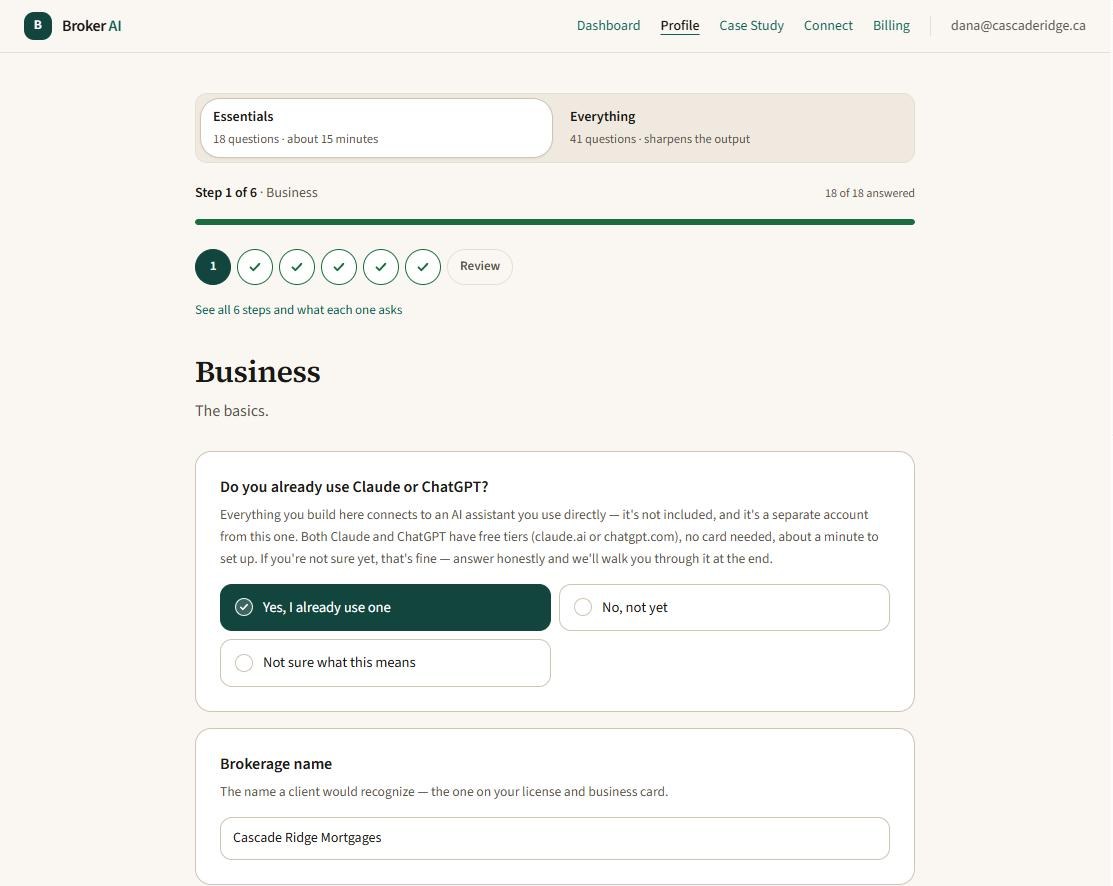
The scorecard above is only half of it. The other half is your profile, a short set of answers about how you run your business. Change one below and watch the file your AI reads rewrite itself.
19 questions like these, across 6 short steps. There are another 24 that sharpen the output — worth doing once you’ve seen it work, not before.
Generated live from the answers on the left — the same file your AI reads, by the same code that builds it.
Four steps. Then you can see what pays.
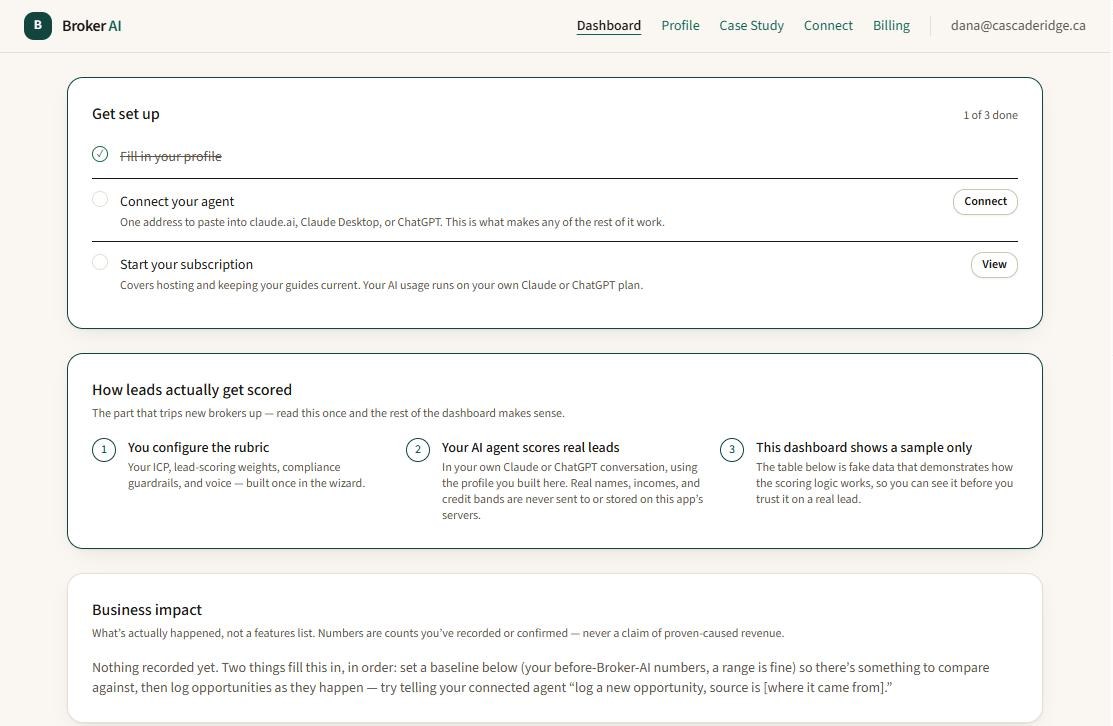
Tell Broker AI how you operate
Who you want to work with, how you qualify a lead, your priorities, your voice, your compliance limits.
Broker AI builds your profile
Structured, current, and entirely separate from any client data — more on that below.
Your AI reads it
Connect Claude, ChatGPT, or any compatible agent, and it reads your profile before it answers you. Correct it and it gets sharper for your practice.
See what pays
On Growth, connect your Google and Meta ads and enter what you pay each lead vendor. The scorecard ranks every source by cost per funded file.
Why not just paste this into ChatGPT yourself?
You can — plenty of brokers try. Here's where it usually breaks down.
Your client files never leave your desk.
Broker AI doesn't need your borrower database to teach your AI how your brokerage operates. It never has.
- What we store
- Your preferences and rules — who you want to work with, how you qualify, your voice, your compliance limits.
- What we never store
- Real client names, incomes and credit files. They are never sent to or held on our servers.
- Where the work happens
- Inside your own AI conversation, on your own account, every time.
You’re not learning an AI. You’re teaching one.
AI already knows mortgages. What it doesn't have is judgment — who’s worth your time, what you won't touch, how you talk to people, where your lines are. That took you years. Writing it down takes about 15 minutes.
Broker AI isn't a chatbot. It hands what you wrote to the assistant you already use — as a live connection, so your agent always sees your current profile with nothing to re-download when you change it. Prefer not to connect at all? Download the same thing as a folder of files.
Change your mind about which AI you use next year and your profile moves with you — not with whichever one you started on.
Not sure which AI to use? DisruptionIO, the company behind Broker AI, helps brokers and firms choose an AI setup: Claude, ChatGPT, or devs.ai (models from the major AI providers on one platform)*, plus custom workflows if you need them. Talk to us. DisruptionIO earns a commission if you sign up for devs.ai through us.
Want to see exactly how it works first? Download the working guide — setup, the prompts worth copying, and the questions brokers ask. No signup.
- ClaudeCowork or Projects — live connection
- ChatGPTProjects — live connection or file download
- Claude CodeLive connection
- CodexLive connection
- Other AI assistantsAnything supporting MCP, or that can read a folder of files
Nothing to install and no API key to generate. The free plan of Claude or ChatGPT is enough. No AI account yet? Download your profile as files instead and connect later.
Your AI works the whole file. Broker AI checks it before anything leaves.
The hard part of AI that does real work was never the AI. It’s knowing it followed your rules, didn’t skip a step, and didn’t send anything you hadn’t seen. So we’re building one agent for each stage of a file, and every one of them runs through Broker AI:
- New leadscores it, records it, drafts a same-day reply with your required disclosure first
- Discovery calla brief before the call; a summary, red flags and next steps after it
- Before the credit pullconsent, ID, third-party and PEP checks each confirmed and recorded
- Proposal follow-upday-2 and day-5 nudges, and a heads-up to you when a client goes quiet
- Disclosure paperworkdrafted from the commitment, checked, and filled on the regulator’s own form
- Closing packagewhat’s on the file against the closing list and the lender’s conditions
- Fundedthe outcome recorded, the client’s congratulations and the partner’s thank-you drafted
Every draft is checked against your rules. A file can’t move past a step that isn’t done. Nothing goes to a client or lender until you approve it.
All seven are built and in testing with one broker. They aren’t available yet; want to be next? broker@disruptionio.com
Built with a broker, not for a hypothetical one.
Broker AI is built by DisruptionIO, a technology advisory serving North America with deep expertise in Canada. Choosing technology, reading the contract, and making it work afterwards is the job we already do — across telecom, cloud, cybersecurity and AI, on a network of 400+ suppliers.
We built the first version of this for a working mortgage broker who asked for it. It turned out to be worth more than a one-off, so we're offering it to other brokers under our own name — same company, same owners. We run AI across our own operations every day; we're not selling you something we don't use ourselves.
Want to talk to a person first? 778-658-6990
- Marc Kester
- 25+ years in telecom at Rogers and Shaw.
- Russ Herman
- Came up the same way, and has spent his career helping businesses cut through technology complexity.


Own your marketing, without buying a course.
We've heard of a marketing coaching package quoted in a market where we have contacts: CA$5,000 to get started and CA$500 a month after that — before a dollar of ad spend.
The idea behind it is a good one: you learn and own your marketing instead of renting an agency. Broker AI is built on the same idea — and it's there for the parts a monthly call can't be.
- It’s there every time you need it, not once a month. Your AI already knows your ideal client, your voice and your compliance lines, so it drafts a post, a video script or ad copy the moment you ask — in your words, for your market.
- It learns you, and keeps learning. Every correction you make is recorded. Correct the same thing three times and it’s proposed as a rule for you to approve. Your lead scoring sharpens the same way. A course teaches you once; this keeps up with you.
- Your AI checks drafts before you use them. Against your brokerage’s compliance rules — the phrases that must be there, the ones that never can, the situations that need a disclosure or a second look.
- Targeted ads, with guardrails you can’t forget to apply. Your AI proposes campaigns and budget changes. Each is checked against Meta’s rules for credit ads — no targeting by age or gender, no tight postal-code circles, no lookalikes — and against the spending ceiling you set, then waits for your click. No proposal gets past the ceiling you set.
- You stay the advertiser. A new campaign arrives paused. You finish it in your own Meta or Google account and switch it on, because you’re the one answerable for the ad — and there’s a record of who approved what, and when.
- You see which ads end in a funded file. Every lead carries where it came from through to funded, so you see cost per funded file by campaign, not just cost per lead.
- Add to what you’re already good at. Brokers can add skill files — instructions others have written for AI assistants — to sharpen their own AI further. What you add is your call; we don’t vet or endorse anyone else’s.
What a coach gives you that we don't: a person on the call. If that's what you want, the two work together — your coach's advice becomes rules in your profile, and your AI applies them every day.
Or an agency that runs your ads for you.
Done-for-you works until you look at what you're paying for. Bringing it in-house with Broker AI changes three things:
- Measured on funded files, not leads. An agency report counts leads. You get paid on files that fund. Broker AI follows every lead from the campaign it came from to funded, so the question “which ads actually made me money?” has an answer.
- Your process stays when the contract ends. Your campaigns live in your own ad accounts, and the rules you’ve learned live in your profile — not in someone else’s playbook.
- Nothing runs that you haven’t seen. Every campaign and budget change waits for your approval, inside the compliance and spending limits you set. You’re never finding out about a campaign after it’s spent.
Less than half that package's first year, even after converting US dollars to Canadian — and it's with you every day, not once a month.
Free while we're in pilot.
No card on file. Nothing charged.
- Everything: the 19-question essentials, plus the 24 that sharpen it
- Connect it live to your AI, or download it as files
- Version history on every change
- Reads your Google and Meta (Facebook and Instagram) ad performance and prepares changes for your approval — never spends a dollar on its own
19 questions, about 15 minutes · Sign in first, then straight into it · Free, no card
- Client-facing drafts checked against your rules and your brokerage’s before you see them, with a record of every check
- Brokerage-wide rules, set once and applied to every broker
- A compliance record you can download for your principal broker or regulator
- Your AI business profile — ideal client, how you qualify, your voice, referral strategy, compliance boundaries — versioned
- Works with the AI your firm approves; corrections become rules; opportunity and outcome tracking
- No client data stored, by design
- Everything in Broker AI
- Meta and Google campaigns and budget changes proposed by your AI
- Each one checked against Meta’s credit-ad rules and your spending ceiling, then approved by you
- See which ads end in a funded file, not just which ones produce leads
- A lead-source scorecard: Zillow, LendingTree and other vendors, Google and Meta ads, referrals and past clients, ranked by cost per funded file
- Ad spend is paid to Meta or Google, not us
Prices are in US dollars, per broker. Brokerages with 50 or more brokers get group pricing — see how it works for brokerages. You'll get notice before the pilot ends, and nothing is charged without your say-so. Prices cover Broker AI itself — your AI plan is separate.
Need a controlled AI environment? Broker AI is model-agnostic and works with the AI environment your firm approves — Microsoft, Claude, ChatGPT or others. For firms that want several models through one enterprise-controlled platform, we can provide access to Devs.ai.
Questions brokers actually ask.
Does this replace my CRM?
No. Your CRM tracks clients and pipeline — who this person is, what stage they’re at, what happened last. Broker AI answers a different set: is this the type of opportunity I want, how would I evaluate it, what should my AI prioritise, how should it communicate, what should it avoid. They sit side by side, and nothing here asks you to move your pipeline.
How does it know which leads actually funded?
Your AI records the outcome as you work with it: a lead funded, was declined, or was lost. You can also import past leads from a spreadsheet. The scorecard puts those records next to the ad spend it reads from your Google and Meta accounts and the vendor costs you enter once. A source with too few leads to mean anything is marked “too early to compare.”
Can’t I just paste this into a custom-instructions box myself?
You can, and plenty of brokers try. The usual problems: it only lives in whichever tool you pasted it into, it goes stale with no record of what changed, and it never gets sharper on its own. Broker AI is one profile, live everywhere you connect it, versioned, and built to improve every time you correct it.
Claude already remembers me. Why do I need this?
Because remembering and being told are different things. Claude and ChatGPT keep a running sense of what you have mentioned — useful, and free. What they cannot do is ask. Nobody prompts you for your LTV limits, your renewal window, which referral partners matter, or the phrases you will never put in writing, so those never get said and never get remembered. Four other differences that matter in a licensed business: your profile works with Claude and ChatGPT and moves with you if you switch; every change is versioned, so you can show what your rules were in March; anything your AI wants to change has to be proposed and approved by you rather than quietly absorbed; and your answers come back as real files — an ICP document, a scoring rubric, a voice guide — that you own.
Does it get better the more I use it?
Yes, and you stay in charge of how. Every time you change or remove something it wrote, that correction is recorded. When the same phrase has been corrected three times, a rule naming it is proposed on your dashboard — with the dates and the count — for you to approve or reject. Nothing becomes a rule until you say so, and you can always see why it was suggested. And when your brokerage or regulator issues new rules, you paste the document in, it proposes the specific rules, and you approve them. From then on, your AI checks drafts against what you approved.
Does Broker AI see my client data?
No. Real client names, incomes and credit files never touch our servers. Broker AI stores your preferences and rules, not your clients — the actual work on a real lead happens in your own AI conversation, on your own account.
What AI tools does this work with?
Claude (Cowork or Projects), ChatGPT Projects, Claude Code, Codex, and any other assistant that supports MCP — an open standard for connecting tools to AI assistants — or that can read a folder of project files.
Our compliance officer wants a controlled AI environment. Does that work?
Yes. Broker AI is model-agnostic and works with the AI environment your firm approves — Microsoft, Claude, ChatGPT or others. For firms that want several models through one enterprise-controlled platform, we can provide access to Devs.ai.
How hard is it to connect?
There’s nothing to install and no API key to generate. You copy one web address from your dashboard and paste it into your assistant’s connector settings — in Claude that’s Settings → Customize → Connectors → Add custom connector; in ChatGPT it’s Plugins → Add → Add custom MCP server. You then sign in once and click Authorize. It takes about two minutes, and the page walks you through it. If you’d rather skip connecting entirely, download your profile as a folder of files instead.
I don’t have Claude or ChatGPT yet. Is that a problem?
Not a problem. The free plan of either one is enough to connect, and it takes a minute to create an account at claude.ai or chatgpt.com; it is a separate account from your Broker AI one. Build the profile first either way — the setup page walks you through connecting at the end.
Not sure which AI to use? DisruptionIO, the company behind Broker AI, helps brokers and firms choose an AI setup: Claude, ChatGPT, or devs.ai (models from the major AI providers on one platform)*, plus custom workflows if you need them. Talk to us. DisruptionIO earns a commission if you sign up for devs.ai through us.
Do I have to finish it in one sitting?
No. Your answers save as you go, on our server rather than in your browser, so you can stop partway through and pick up where you left off — on a different device if you want.
What does it cost?
Free during our pilot, no card required. After the pilot: US$149 a month per broker for Broker AI — your business AI profile plus governance: drafts checked against your rules and your brokerage’s, brokerage-wide rules, and a compliance record — or US$299 a month per broker for Broker AI Growth, which adds Meta and Google advertising with every change approved by you. Brokerages with 50 or more brokers get group pricing. That covers Broker AI itself — your AI plan is separate (Broker AI works with whichever AI your firm approves), and ad spend is paid to Meta or Google. You’ll get notice before the pilot ends.
Can Broker AI run my ads for me?
It can connect to your Meta and Google ad accounts to read real performance and prepare a change for you. It never places an ad or spends money on its own — every change needs your explicit approval, every time.
What if I stop using it?
Your AI simply stops having that context. There’s nothing to unwind, because there was never any client data here to begin with.

Find out which leads actually fund.
15 minutes to set up. Then connect your ads and see what pays for itself, with an AI that already knows how you work.